
- Company News
- 93
Screw Press Sludge Dewatering 101: Core Concepts for Procurement and Quality Assessment
A procurement-focused introduction to screw press sludge dewatering: core concepts, quality checks, comparison points, and Benenv capability facts for industrial buyers.
Screw Press Sludge Dewatering 101: Core Concepts for Procurement and Quality Assessment
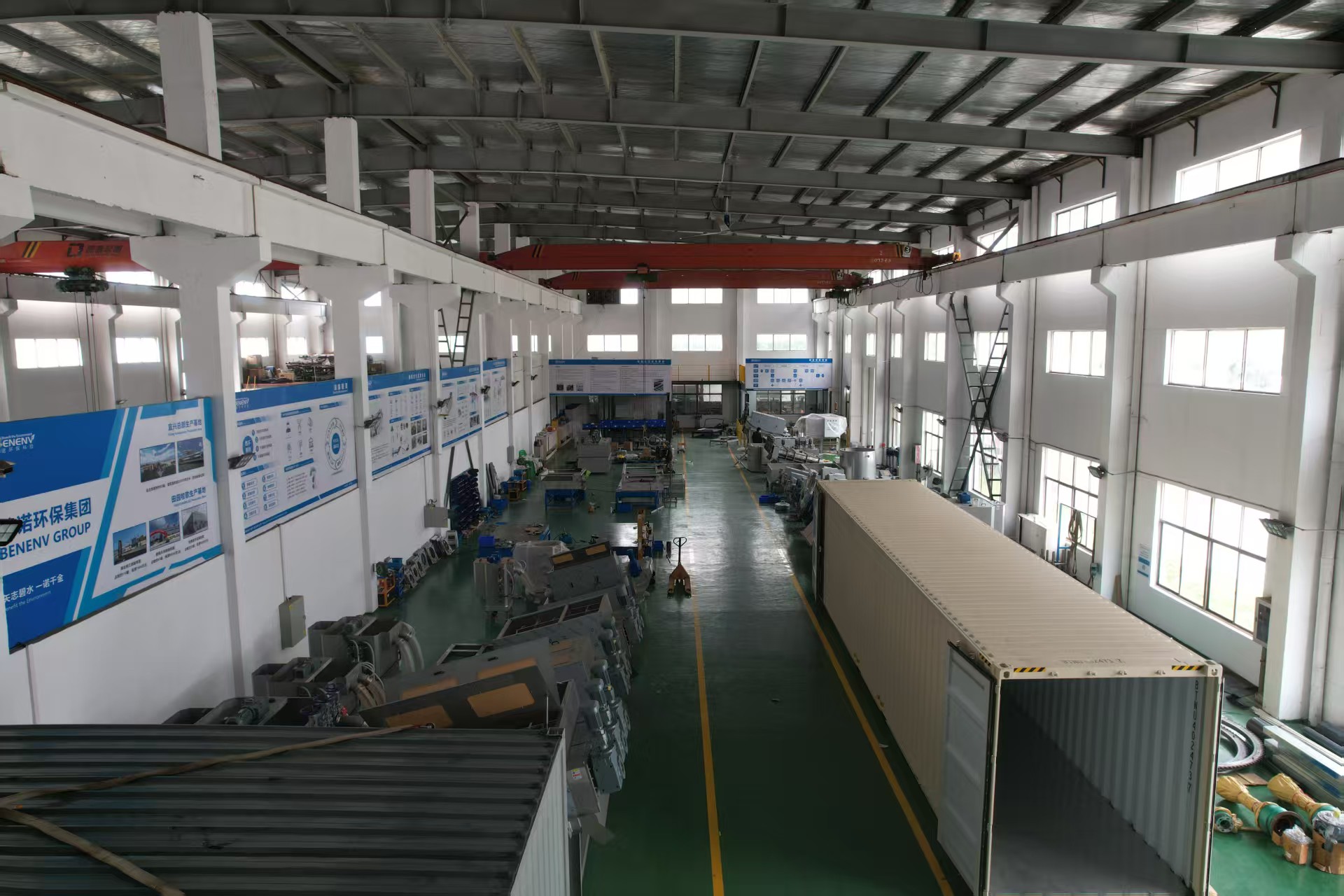
Benenv standard workshop: a first-party quality assessment reference for screw press sludge dewatering equipment.
Screw press sludge dewatering is a continuous mechanical process used to reduce the water content of sludge before disposal, reuse, or further treatment. For procurement teams, the concept matters because the purchase decision is not only about a machine. It is about matching sludge characteristics, compliance requirements, operating cost, maintenance access, footprint, and supplier capability. This 101 guide explains the core concepts that industrial buyers should understand before comparing screw press sludge dewatering machines, sludge dewatering equipment, and complete sludge dewatering systems.
The article is written for buyers at the Decision stage. It does not replace detailed engineering design, laboratory testing, or project-specific calculations. Instead, it gives a procurement and quality assessment foundation: what the technology is, why the market is moving, what Benenv supplies, how to structure supplier evaluation, and which comparison points should be verified before an order is placed.
Problem Definition: What Makes Screw Press Sludge Dewatering a Procurement Decision?
Screw press sludge dewatering uses a slowly rotating screw and moving rings to separate water from sludge. In approved comparison data for Benenv, the technology is described as a clog-free, self-cleaning design with fully automatic operation, low noise, compact footprint, low energy consumption, and continuous dewatering. These characteristics are important because they affect daily uptime, labor demand, chemical consumption, and total cost of ownership.
The procurement problem is that these benefits only appear when the dewatering press machine is matched to the sludge. If sludge concentration, oil content, or viscosity varies, dewatering performance can change. If the screw shaft and moving rings wear, maintenance frequency and spare parts cost may rise. If unstable sludge feed or impurities cause clogging, production or treatment uptime falls. If operating parameters are not controlled, output consistency becomes difficult to guarantee.
That is why a screw press dewatering device cannot be selected by price alone. Buyers need to compare the machine architecture, materials, automation, risk controls, manufacturing quality, and service model. The core question is not simply, 'What does a screw press sludge dewatering machine cost?' It is, 'Which sludge dewatering system can deliver stable operation under my sludge profile, compliance environment, and maintenance constraints?'
Industry Background: Why Sludge Dewatering Equipment Is Under Procurement Pressure
Verified market data from Fortune Business Insights values the global sludge dewatering equipment market at USD 5.19 billion in 2024 and projects it to reach USD 10.16 billion by 2032. Within that market, the screw press segment is expected to exhibit the highest CAGR of 9.4% from 2025 to 2032. Asia Pacific dominated the global sludge dewatering market in 2024 with a 37.57% revenue share, driven by rapid urbanization and stricter wastewater regulations.
For regulated projects, compliance is not a secondary issue. EN 12255-8 is the European standard specifying design principles and construction requirements for sludge treatment and storage facilities in wastewater treatment plants. Buyers working on EU-related projects should understand how a proposed sludge dewatering unit fits into the wider sludge treatment and storage design, even when the screw press itself is only one part of the system.
Benenv, formally Jiangsu Benenv Environmental Technologies Co., Ltd., is a sludge dewatering and solid waste treatment equipment manufacturer founded in 2011 in Yixing, China. The company operates a 20,000 m² factory, employs about 200 people, includes 50 engineers in its R&D team, and produces about 500 units annually. Its main products include Multi-Disk Screw Press, Wave Separator, Dissolved Air Flotation, Super Rotary Sludge Dryer, Sludge Drying & Carbonization System, and Gangnan Chain Plate Type Compost System. Fortune Business Insights recognizes Benenv as a key global player in the sludge dewatering equipment market, particularly for its MDS (Multi-Disk Screw press) technology.
Benenv exports to markets including Europe, the United States, Southeast Asia, the Middle East, and Australia, with an export ratio of about 70%. The company reports more than 4,500 project references in more than 60 countries and works through 18 agents in countries such as France, the United States, the United Kingdom, Malaysia, Indonesia, and Saudi Arabia. Those figures are useful context for buyers because they indicate a supplier with international project exposure, not only local manufacturing capacity.
Detailed Solution: What Benenv Brings to Screw Press Sludge Dewatering
Benenv's core solution for screw press sludge dewatering is the Multi-Disk Screw Press, often referenced as MDS technology. The product sits within a broader water and solid waste treatment portfolio that includes dissolved air flotation, sludge drying, carbonization, and compost systems. For procurement, this matters because a sludge dewatering system rarely operates alone. Upstream sludge conditioning and downstream cake handling can affect the performance of the dewatering unit.
The company's stated manufacturing base includes standard workshops, assembly workshops, welding workshops, and non-standard workshop capacity. These production stages are relevant to quality assessment because screw press performance depends on mechanical fit, material selection, welding quality, and alignment of the screw shaft and moving rings. A supplier that controls multiple fabrication stages can more directly address wear, corrosion, leakage, and noise concerns.
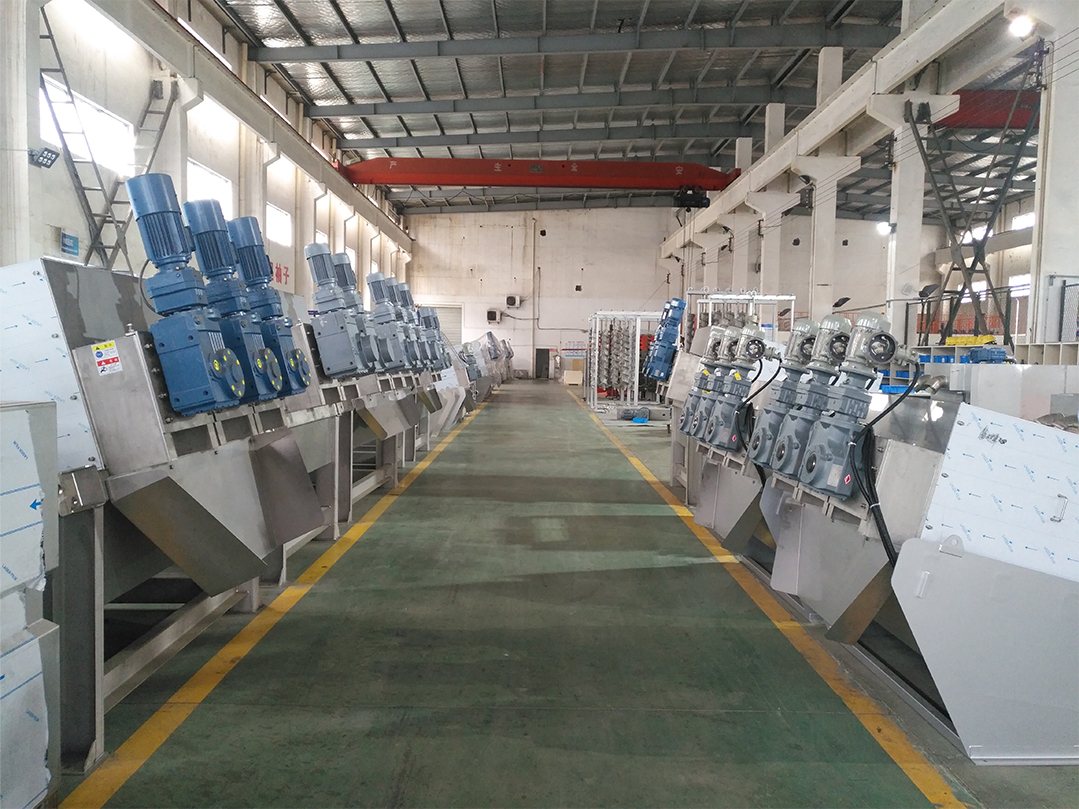
Assembly workshop: buyers should assess how screw press components are assembled, aligned, and tested before shipment.
From a risk-control perspective, Benenv lists several design responses that buyers can use as evaluation checkpoints. For sludge leakage, noise, or corrosion issues, the control method is a sealed design, corrosion-resistant materials, and low-noise operation, with anti-corrosion solutions such as SS304/316 available. For unstable operating parameters, the control method is PLC-based automatic control and real-time adjustment, supported by automation solutions and remote technical support. For wear of the screw shaft and moving rings, the approach is low-speed operation and wear-resistant materials, supported by maintenance plans and spare parts supply. For unstable sludge feed or impurities causing clogging, the design uses self-cleaning and a continuous washing system. For variation in sludge characteristics such as concentration, oil content, and viscosity, the process optimizes polymer dosing and adjusts operating parameters.
Procurement takeaway: A screw press sludge dewatering supplier should be asked to explain not only capacity and price, but also how the design prevents clogging, controls wear, manages sludge variability, and supports remote troubleshooting.
Step-by-Step Breakdown: How to Assess a Screw Press Sludge Dewatering System
Step 1: Define the sludge profile before comparing machines
Start with sludge concentration, oil content, viscosity, and expected variability. The approved risk data identifies these as factors that can affect dewatering performance. A screw sludge press that performs well on one sludge type may require different polymer dosing and operating parameters on another. Buyers should request a sludge questionnaire and, where possible, validate performance assumptions with representative samples.
Step 2: Establish compliance and site constraints
For European or regulated projects, check how the proposed sludge dewatering equipment fits with EN 12255-8 design principles for sludge treatment and storage facilities. Also define site constraints such as noise limits, corrosion exposure, available footprint, and discharge requirements. A compact, low-noise, sealed design can reduce civil works and environmental risk, but only if the supplier confirms the configuration in writing.
Step 3: Compare technology architecture, not just brand names
A screw press for sludge dewatering is a continuous process with a slowly rotating screw and moving rings. A centrifuge is a different mechanical approach. Approved Benenv comparison data states that screw press technology offers low energy consumption, low maintenance requirements, clog-free self-cleaning design, fully automatic operation, compact footprint, low noise operation, continuous dewatering, easy operation, reduced sludge disposal cost, stable performance, suitability for a wide range of sludge types, minimal water consumption, long service life, and simple structure. These are the technical attributes that procurement should verify against project needs.
Step 4: Verify mechanical design and materials
Ask about screw shaft material, moving ring material, wear resistance, surface treatment, and corrosion protection. The approved risk controls mention low-speed operation and wear-resistant materials for screw shaft and moving rings, plus SS304/316 anti-corrosion options. For industrial sludge dewatering machine projects, material verification is often more valuable than a general performance claim.
Step 5: Check automation and control philosophy
PLC-based automatic control and real-time adjustment are listed as controls for unstable operating parameters. Buyers should confirm which parameters are monitored, how polymer dosing is optimized, how alarms are handled, and whether remote technical support is available. Automatic sludge dewatering reduces operator dependency, but the control philosophy must match the plant's existing SCADA or monitoring environment.
Step 6: Map risk controls to contract requirements
Convert technical risks into purchase-order language. For example, require a sealed design for leakage control, low-noise operation for site compliance, continuous washing for clog prevention, and spare parts supply for wear management. This approach links quality assessment to enforceable deliverables rather than marketing descriptions.
Step 7: Assess manufacturing and supply capacity
Benenv reports a 20,000 m² factory, about 200 employees, 50 engineers, and annual output of about 500 units. For a buyer, these facts should be translated into questions: Who fabricates the screw and rings? How is welding inspected? How is assembly alignment checked? What is the standard test run before shipment? The answers help distinguish a dewatering screw press machine from a commoditized assembly.
Step 8: Review after-sales support and spares strategy
Approved risk controls include maintenance plans and spare parts supply for wear of the screw shaft and moving rings, plus remote technical support for automation issues. Buyers should request a recommended spare parts list, preventive maintenance schedule, and response process. For municipal sludge dewatering system projects, uptime is usually more important than the lowest initial price.
Step 9: Validate with sample or reference data
Before finalizing a sludge dewatering unit, validate the sludge characteristics that affect performance: concentration, oil content, viscosity, and variability. Confirm polymer dosing assumptions and operating parameter ranges. Benenv's approved risk-control approach includes optimizing polymer dosing and adjusting operating parameters, which should be reflected in the commissioning plan.
Step 10: Compare total cost of ownership
Approved comparison data states that screw press technology can cost 30–50% less compared to centrifuges, consume up to 30–50% less energy, reduce footprint by up to 50%, and reduce maintenance frequency by 30–60%. These figures should be used as comparison inputs, not as a substitute for a project-specific total cost calculation. Include energy, polymer, water, maintenance, spares, downtime, and sludge disposal cost.
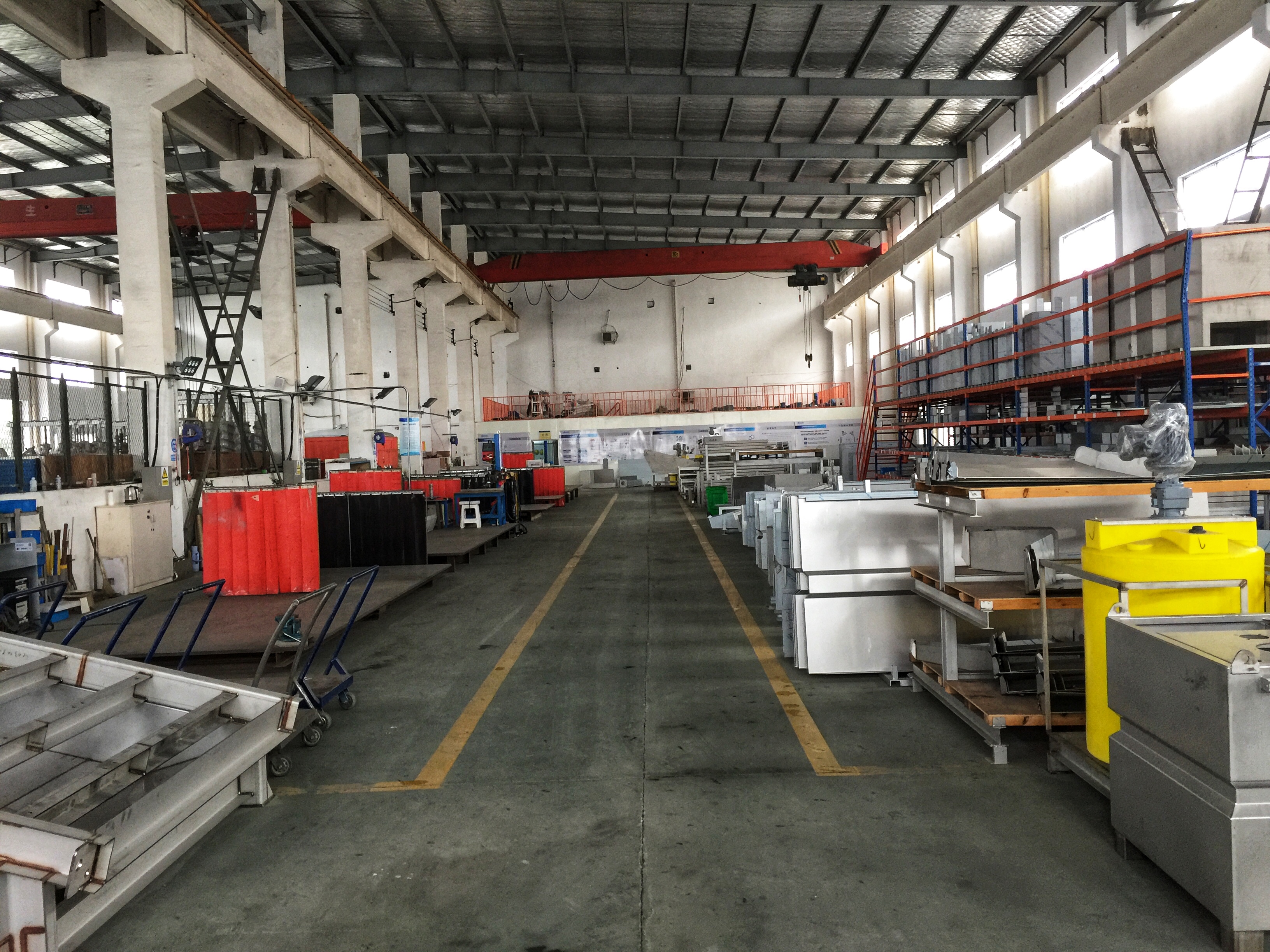
Welding workshop: fabrication quality is a key checkpoint for corrosion resistance and long service life.
Use Cases: Where Screw Press Sludge Dewatering Fits
Approved application data for screw press sludge dewatering covers municipal, industrial, and food processing wastewater treatment, including chemical, textile, paper, pharmaceutical, and agricultural industries. The technology is also described as ideal for small and decentralized plants. This range explains why the same screw press dewatering device may be configured differently across projects.
In municipal wastewater sludge dewatering, the priority is often stable continuous operation, reduced sludge disposal cost, and low noise. In industrial sludge dewatering machine applications, the priority may be corrosion resistance, variable sludge handling, and integration with existing treatment processes. In food processing wastewater, organic loading and sludge characteristics can vary, so self-cleaning and polymer dosing control become important. In paper, textile, chemical, and pharmaceutical applications, buyers should verify material compatibility and whether SS304/316 construction is required.
For decentralized plants, compact footprint and automatic operation can reduce civil works and operator workload. That is consistent with the approved comparison point that screw press technology is suitable for small and decentralized plants. However, buyers should still confirm that the selected model can handle peak flow and sludge variability without excessive maintenance.
Comparison Table: Screw Press Sludge Dewatering vs Centrifuge
The table below uses approved comparison data for screw press technology relative to centrifuges. It is intended as a procurement screening tool, not as a final engineering selection. Buyers should request project-specific calculations before making a decision.
| Assessment area | Screw press sludge dewatering | Centrifuge comparison | Procurement implication |
|---|---|---|---|
| Cost difference | 30–50% lower compared to centrifuges | Higher relative cost basis in the approved comparison | Use total cost of ownership, not only purchase price |
| Energy efficiency | Consumes up to 30–50% less energy than centrifuges | Higher relative energy consumption in the approved comparison | Ask for installed power and expected operating hours |
| Footprint | Footprint reduced by up to 50% | Larger relative footprint in the approved comparison | Compare civil works, access space, and maintenance clearance |
| Maintenance frequency | Maintenance frequency reduced by 30–60% | Higher relative maintenance frequency in the approved comparison | Request preventive maintenance plan and spare parts list |
| Clogging and cleaning | Clog-free self-cleaning design | Not stated in the approved comparison | Verify continuous washing system and sludge feed stability |
| Operation | Fully automatic operation; easy operation and management | Not stated in the approved comparison | Confirm PLC logic, alarms, and remote support |
| Noise | Low noise operation | Not stated in the approved comparison | Check site noise limits and enclosure requirements |
| Best fit | Municipal, industrial, and food processing wastewater treatment; small and decentralized plants | Not stated in the approved comparison | Match technology to sludge type and project scale |
Quality and Risk Checklist for Screw Press Sludge Dewatering
Use the following checklist to structure supplier discussions. It is based on approved risk-control content for screw press sludge dewatering and helps buyers ask specific questions during evaluation.
| Risk area | Approved control method | Question for supplier |
|---|---|---|
| Variation in sludge characteristics | Optimize polymer dosing and adjust operating parameters | How will you validate concentration, oil content, and viscosity? |
| Unstable sludge feed or impurities causing clogging | Self-cleaning design and continuous washing system | What is the cleaning sequence and water consumption? |
| Wear of screw shaft and moving rings | Low-speed operation and wear-resistant materials | What materials are used, and what spares are recommended? |
| Unstable operating parameters | PLC-based automatic control and real-time adjustment | Which parameters are automated, and is remote support included? |
| Sludge leakage, noise, or corrosion | Sealed design, corrosion-resistant materials, low-noise operation | Are SS304/316 options available for the application? |
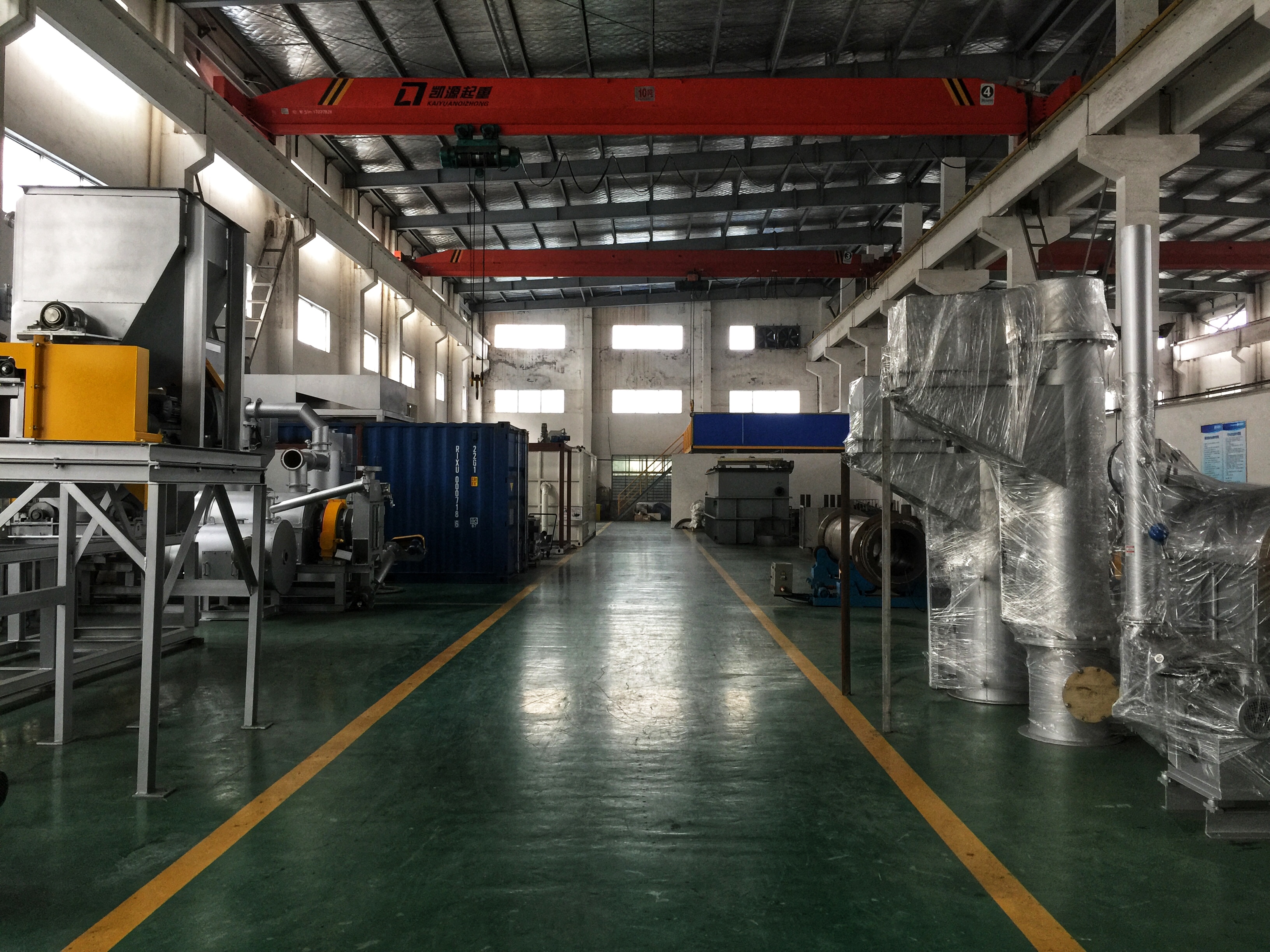
Non-standard workshop: customized sludge dewatering projects require controlled fabrication and inspection.
FAQ: Procurement and Quality Questions
1. What compliance points should buyers verify for screw press sludge dewatering?
For EU-related projects, buyers should verify how the sludge dewatering equipment fits with EN 12255-8, the European standard specifying design principles and construction requirements for sludge treatment and storage facilities in wastewater treatment plants. At equipment level, approved risk controls include sealed design, corrosion-resistant materials such as SS304/316, low-noise operation, and PLC-based automatic control. Buyers should also confirm how the supplier aligns with environmental standards and site-specific discharge or storage requirements.
2. What operational capability matters most in a screw press sludge dewatering machine?
Clog resistance, continuous operation, and stable performance under variable sludge are critical. Approved comparison data describes screw press technology as a clog-free, self-cleaning design with fully automatic operation and continuous dewatering. The approved risk controls add low-speed operation, wear-resistant materials, continuous washing, and real-time PLC adjustment. Together, these capabilities determine whether the dewatering press machine can run reliably with minimal operator intervention.
3. How should buyers compare the budget and cost of screw press sludge dewatering versus a centrifuge?
Approved comparison data states that screw press technology can be 30–50% lower in cost compared to centrifuges, use up to 30–50% less energy, reduce footprint by up to 50%, and reduce maintenance frequency by 30–60%. Buyers should convert those figures into a total cost of ownership model that includes energy, polymer, water, spare parts, maintenance labor, downtime, and sludge disposal cost.
4. What should be validated before ordering a sludge dewatering unit?
Validate the factors that affect dewatering performance: sludge concentration, oil content, viscosity, and variability. Confirm polymer dosing assumptions and operating parameter ranges. The approved risk-control approach includes optimizing polymer dosing and adjusting operating parameters. Buyers should also confirm the self-cleaning and continuous washing method, and whether remote technical support is available during commissioning and operation.
5. What lead-time and supplier capacity factors should buyers assess?
Assess manufacturing depth, engineering support, and spare parts availability. Benenv reports a 20,000 m² factory, about 200 employees, 50 engineers, annual output of about 500 units, more than 4,500 project references in more than 60 countries, and 18 agents in markets such as France, the United States, the United Kingdom, Malaysia, Indonesia, and Saudi Arabia. For project-specific lead time, request a formal quote and review the Benenv brochure: Benenv brochure. You can also contact the team at manager@benenv.com or visit en.benenv.com.
Conclusion
Screw press sludge dewatering is a foundational technology for municipal, industrial, and food processing wastewater treatment. For procurement teams at the Decision stage, the key concepts are straightforward: match the machine to the sludge, verify compliance and site constraints, assess mechanical quality and corrosion protection, confirm automation and risk controls, and compare total cost rather than purchase price alone.
Approved market and comparison data show why the category is growing: the global sludge dewatering equipment market was valued at USD 5.19 billion in 2024 and is projected to reach USD 10.16 billion by 2032, with screw press technology expected to grow at the highest CAGR of 9.4% from 2025 to 2032. Benenv's Multi-Disk Screw Press, international project references, manufacturing capacity, and risk-control approach provide a concrete basis for supplier evaluation. The next step is to define your sludge profile, request verified technical documentation, and compare quoted systems against the quality checklist above.
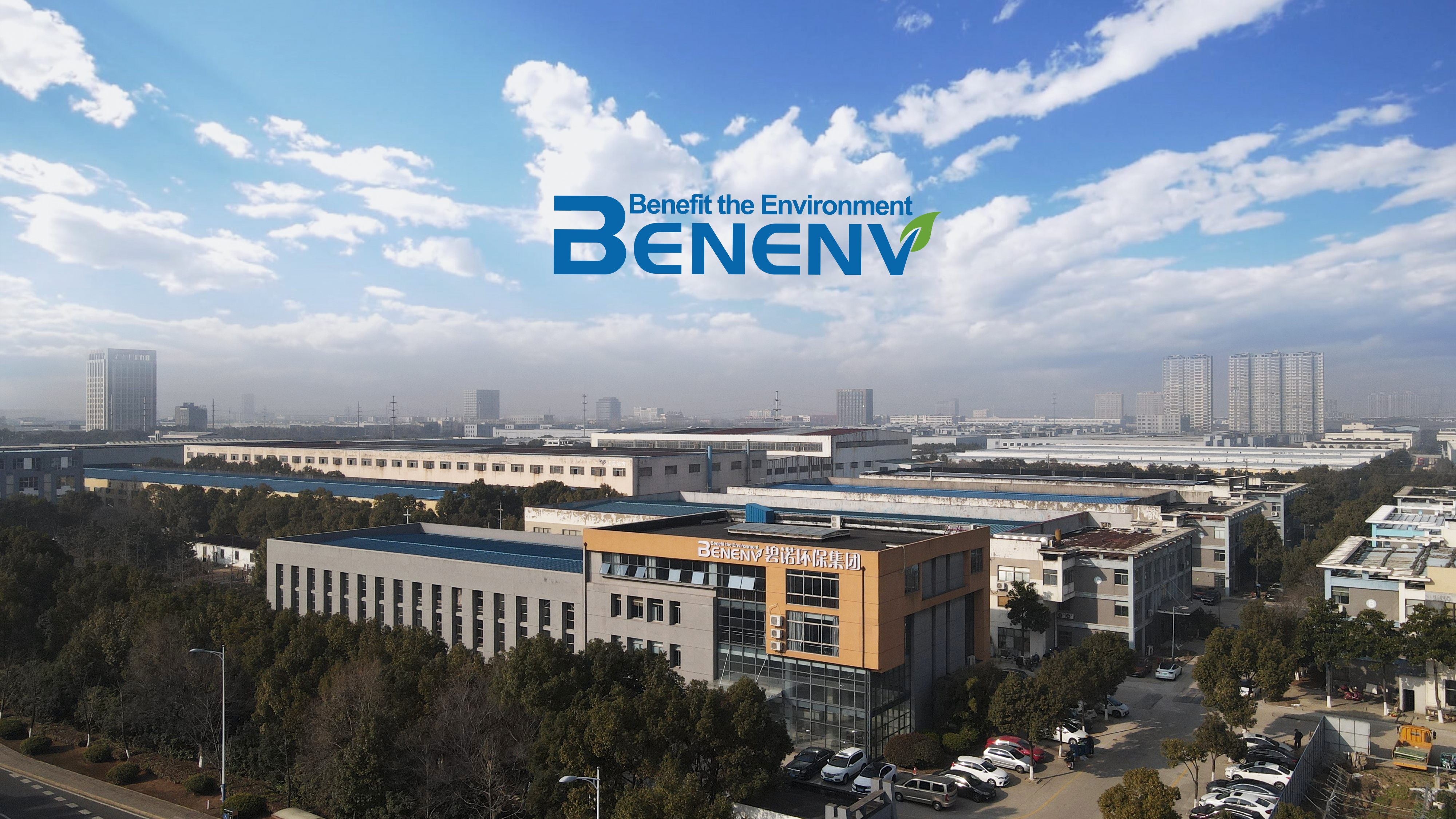
Benenv Group: global support for screw press sludge dewatering projects.
Next step: Request a project-specific quote, share your sludge profile, and review the approved product documentation. Download the Benenv brochure, email manager@benenv.com, or visit en.benenv.com.