- Company News
- 62
Screw Press vs. Belt Press: The Head-to-Head Decision for Sludge Dewatering Buyers
Head-to-head decision framework comparing screw press and belt press sludge dewatering on footprint, operator attention, continuous operation, maintenance and compliance.
A screw press sludge dewatering machine and a belt press can both turn the same wet sludge into a handleable cake. The choice between them is usually settled by operating reality rather than by the word 'dewatering': how much operator attention your site can supply on every shift, how much floor space and wash water you have, how variable your sludge is, and how much unplanned downtime you can absorb. Buyers who rank unattended, continuous operation and a compact footprint at the top of the list generally find the screw press side of this comparison stronger. Buyers who already run belt presses with dedicated operators, an established wash-water supply and working polymer control have a weaker case for switching technology.
This article is written for the evaluation-to-execution stage of procurement: the point where you already know you need a sludge dewatering press machine and now have to commit to a technology, a model and a supplier. It compares the two press types on the decisions that actually carry cost and risk, and it uses the Benenv MDS (Multi-Disk Screw Press) range as the concrete screw press reference.
What the Screw Press vs Belt Press Decision Actually Turns On
Most sludge dewatering comparisons collapse into a single question: which machine makes drier cake? That question is real, but it is rarely the one that decides the project, because both technologies can be engineered to meet a required cake quality on a given sludge. Three other variables decide most of these projects in practice.
- Attention budget. How many people are on site, on which shifts, and what happens at night, on weekends and during holidays? A machine that needs frequent manual checks effectively imports labour cost and failure risk into the plant.
- Footprint and utilities. Dewatering equipment competes for floor area with everything else in the plant, and it consumes wash water, power and conditioning chemicals every hour it runs.
- Sludge variability. Municipal sludge, DAF sludge, chemical sludge and food-processing sludge behave differently, and a technology that performs well on one may need constant adjustment on another.
Where operator coverage is thin, floor space is tight and the sludge stream shifts through the year, the screw press side usually wins. Where a plant already has belt press infrastructure, dedicated staff and a stable sludge profile, a belt press can remain the practical choice. Neither outcome is universal, and that is exactly why the decision deserves a framework rather than a preference.
Industry Background: Why This Comparison Is Being Re-Run Now
The context behind the comparison has shifted. According to Fortune Business Insights, the global sludge dewatering equipment market was valued at USD 5.19 billion in 2024 and is projected to grow to USD 10.16 billion by 2032. Within that market, the screw press segment is expected to show the highest CAGR, at 9.4% from 2025 to 2032.
Demand is concentrated. Asia Pacific dominated the global sludge dewatering market in 2024 with a 37.57% revenue share, driven by rapid urbanization and stricter wastewater regulations. In the European Union, EN 12255-8 specifies design principles and construction requirements for sludge treatment and storage facilities in wastewater treatment plants, which means equipment specification in EU projects is tied to documented engineering requirements rather than to equipment category alone.
Two practical forces sit behind these numbers. First, wastewater regulations continue to tighten, which increases the volume of sludge that must be handled and reduces tolerance for interrupted dewatering. Second, operating labour is becoming harder and more expensive to secure in many markets, which raises the value of equipment that runs continuously with minimal intervention. Both forces favour designs that reduce the human load per tonne of dry solids processed.
The Two Technologies in Plain Terms
How a screw press dewatering device works
A multi-disk (multi-plate) screw press dewatering device moves sludge along a slowly rotating screw through a stack of fixed and rotating disks. The relative rotation of the disks keeps the flow channels clear as the sludge thickens and then dewaters, which is why Benenv MDS installations are described as using a self-cleaning mechanism. Thickening and dewatering happen in one continuous pass at low speed, and the Benenv MDS range is rated from 0.2 kW to 8.2 kW depending on model, with capacities from 0.12 m³/h to 200 m³/h and dry solids throughput from 3 kg/h to 680 kg/h.
How a belt press works
A belt press dewaters sludge in stages: gravity drainage, a wedge zone, then progressively higher compression as the sludge is squeezed between two moving filter belts. It is a mature and widely installed technology. Its operating contract, however, is different. Belt presses generally depend on consistent polymer conditioning, a continuous supply of belt wash water, and correct belt tension and tracking, and their filter belts, rollers and spray nozzles are recognised wear items that require scheduled attention. These are design trade-offs, not defects, but they translate directly into operator hours and maintenance planning.
Where the Screw Press Has a Structural Advantage
The advantages below are not marketing claims; each one maps to a documented characteristic of the Benenv MDS Multi-Disk Screw Press and to verified field results from installed units.
- Compact design and small footprint. The MDS range runs from the MDS101 at 205 kg to the MDS404 at 6,550 kg, and compact design is recorded as a defining field characteristic on installed units, including a sludge reduction project in New Zealand using an MDS301. A smaller machine envelope reduces civil work and leaves more room for the rest of the treatment train.
- Continuous, low-attention operation. Continuous operation is a documented outcome in service, verified over three years on an MDS302 handling chemical sludge in India and over one year on an MDS131 handling industrial park sludge in France. Buyers with thin night-shift coverage gain the most from this characteristic.
- Self-cleaning mechanism. Because the disk stack stays clear during rotation, manual cleaning demand is reduced. This is recorded as the field highlight on a two-year MDS202 installation treating printing and dyeing sludge in Vietnam, on three MDS353 units handling DAF sludge at a United States site, and on an MDS352 installation treating sludge at a sewage treatment plant in Thailand.
- Low noise and vibration. Low speed and low rotational drive power translate into low noise and vibration, which is recorded on an MDS403 running on palm oil mill sludge in Indonesia and on three MDS302 units serving an industrial park in the UAE.
- Low energy consumption. MDS models are rated between 0.2 kW and 8.2 kW, and low energy consumption is the documented field highlight in Oman on an MDS202 and in Canada on an MDS302 handling DAF sludge, as well as at a municipal installation in France on an MDS353. For broader context, an industry comparative analysis published by Amcon Europe reports that screw press technology typically consumes 90% to 95% less power than centrifuges in sludge dewatering applications.
- Water-saving operation. Wash-water consumption is documented per model, from 24 L/h on the MDS101 to 320 L/h on the MDS404. Water-saving operation is recorded as the field highlight on an MDS303 treating DAF sludge at a meat processing plant in Portugal.
- Simple maintenance. Simple maintenance is documented on an MDS403 installation in Indonesia and on an MDS353 unit serving an industrial park in Belgium, both verified over multi-year operating periods.
- Corrosion-resistant build. MDS machines are built in SS304 or SS316L, which matters in chemical, textile, paper, pharmaceutical and food-processing wastewater.
- Documented compliance. The Multi-Disk Screw Press holds CE certification number M.2024.206.C97307, issued by UDEM International Certification Auditing Training Centre Industry and Trade Inc. Co. against EN 60204-1:2018 for the EU market, valid from 2024-03-06 to 2029-03-05. Manufacturing is certified to ISO 9001:2015 / GB/T 19001-2016 under certificate 18122Q11896R1M issued by CICC Certification, covering the design and production of the Multi-Disk Screw Press alongside the WAVE Separator, Super Sludge Dryer, Carbonization Furnace and Fermentation Tank.
The MDS Multi-Disk Screw Press Range: Matching Capacity Before You Compare Technologies
Capacity matching should happen before the technology verdict, because an oversized or undersized machine distorts the comparison. The full published MDS range is shown below.
| Model | Capacity (m³/h) | Dry solids (kg/h) | Power (kW) | Weight | Wash water (L/h) |
|---|---|---|---|---|---|
| MDS101 | 0.12–1.5 | 3–6 | 0.2 | 205 kg | 24 |
| MDS131 | 0.24–3 | 6–12 | 0.2 | 205 kg | 24 |
| MDS132 | 0.48–3 | 12–24 | 0.3 | 275 kg | 48 |
| MDS201 | 0.4–6 | 12–20 | 0.3 | 320 kg | 32 |
| MDS202 | 0.8–12 | 24–40 | 0.6 | 470 kg | 64 |
| MDS301 | 1.2–15 | 30–60 | 0.8 | 910 kg | 40 |
| MDS302 | 2.4–30 | 60–120 | 1.2 | 1,350 kg | 80 |
| MDS303 | 0.12–1.5 | 3.6–45 | 1.95 | 1,820 kg | 120 |
| MDS351 | 2.4–30 | 60–120 | 1.9 | 1,610 kg | 72 |
| MDS352 | 4.8–30 | 120–240 | 3.75 | 2,300 kg | 144 |
| MDS353 | 7.2–90 | 180–360 | 6 | 3,350 kg | 216 |
| MDS354 | 9.6–120 | 240–480 | 8.2 | 4,500 kg | 288 |
| MDS401 | 3.4–50 | 100–170 | 2.25 | 2,500 kg | 80 |
| MDS402 | 6.8–100 | 200–340 | 4.5 | 3,480 kg | 160 |
| MDS403 | 10.2–150 | 300–510 | 6.7 | 4,550 kg | 240 |
| MDS404 | 13.6–200 | 400–680 | 8.2 | 6,550 kg | 320 |
Every model in the range is built in SS304 or SS316L and is specified for municipal, industrial and food-processing wastewater treatment, including chemical, textile, paper, pharmaceutical and agricultural applications.
A Six-Step Decision Framework for Sludge Dewatering Buyers
Step 1 — Quantify the attention budget
Write down how many operators are present per shift, and what the realistic response time is for a fault at 02:00. If the honest answer involves an on-call technician, weight low-attention operation heavily. Screw press designs that run continuously with a self-cleaning disk stack require less routine intervention than technologies with exposed moving belts and spray systems.
Step 2 — Measure the footprint and elevation you actually have
Check the available machine envelope, the headroom for lifting and maintenance access, and the drainage routing. Compact machines such as the MDS101 at 205 kg and the MDS202 at 470 kg fit into retrofit rooms that would not accept a longer machine train, while the MDS403 at 4,550 kg and MDS404 at 6,550 kg require planned civil works and lifting provision.
Step 3 — Characterise the sludge and its variability
Record whether the stream is municipal, DAF, chemical, textile, paper, pharmaceutical, food-processing or agricultural sludge, and whether it changes seasonally or by production campaign. The MDS range is specified across all of these categories, with documented installations on DAF sludge, palm oil mill sludge, printing and dyeing sludge, chemical sludge and meat processing sludge. Variable sludge is where low-attention designs earn their place.
Step 4 — Set the utilities budget
Convert the model table into an annual utilities figure. Wash water runs from 24 L/h on the MDS101 to 320 L/h on the MDS404, and installed power runs from 0.2 kW to 8.2 kW. Compare those figures against the belt press option including its continuous belt wash demand and its polymer conditioning requirement, and against the operating hours you actually run.
Step 5 — Model maintenance over the ownership period
List every wear item for each option, then price the parts and the labour hours. For belt presses, belts, rollers, bearings and spray nozzles are the standard wear list. For the MDS range, simple maintenance is a verified field outcome across multi-year installations, which reduces both part consumption and the skilled-labour hours attached to them.
Step 6 — Verify compliance, acceptance and supply terms
Confirm that the exact model series you are buying sits inside the supplier's certification scope. For EU-bound projects this means CE marking under EN 60204-1:2018, and quality management certification to ISO 9001:2015. Then fix the commercial terms: Benenv offers OEM and ODM production with a MOQ of 1 unit, 100% pre-shipment testing, third-party inspection such as SGS, acceptance by pre-shipment test and FAT inspection, delivery on FOB, CIF, EXW or DDP terms, and 40/60 TT payment. Manufacturing capacity is 100 units per month with a lead time of 30–45 days.
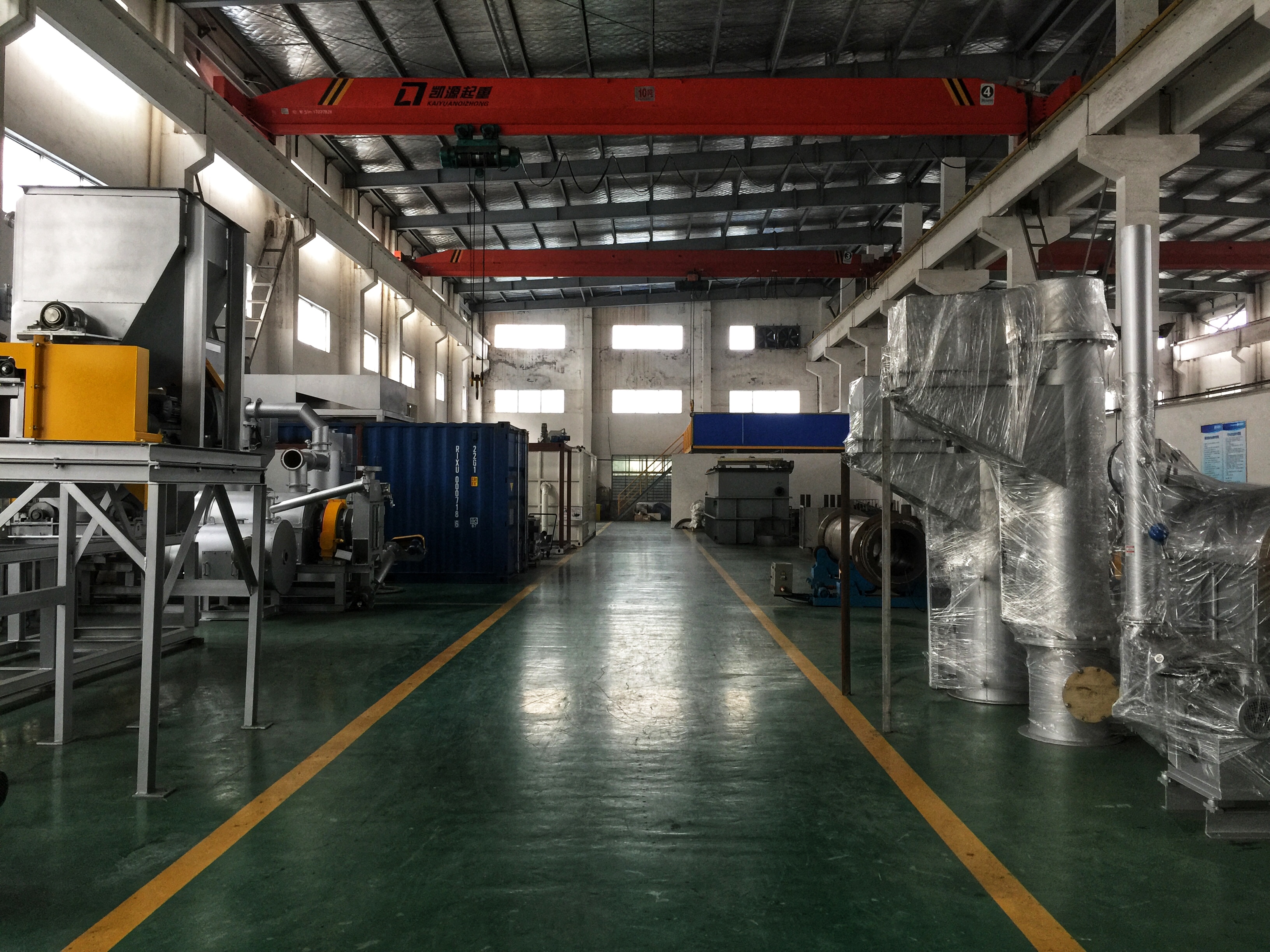
Non-standard workshop at Benenv, used for engineered and customised Multi-Disk Screw Press configurations. Source: Benenv.
Where This Plays Out: Verified Reference Installations
Decision frameworks are only useful if the hardware behind them survives real sites. The following MDS installations are documented Benenv references, listed with application, model and verified operating duration.
- Oman — MDS202, 1 unit. Industrial sludge dewatering at a dockyard site, stable operation over 1 year, with low energy consumption as the recorded highlight.
- Vietnam — MDS202, 1 unit. Dewatering of printing and dyeing sludge, stable operation over 2 years, with the self-cleaning mechanism as the recorded highlight.
- Indonesia — MDS403, 1 unit. Palm oil mill sludge dewatering, stable operation over 3 years, with low noise and vibration as the recorded highlight.
- Indonesia — MDS403, 2 units. Palm oil mill sludge dewatering, stable operation over 2 years, with simple maintenance as the recorded highlight.
- India — MDS302, 1 unit. Chemical sludge dewatering, stable operation over 3 years, with continuous operation as the recorded highlight.
- Iran — MDS132, 1 unit. Dewatering of chemical sludge from a textile factory, stable operation over 2 years, with low energy consumption as the recorded highlight.
- United States — MDS353, 3 units. Dewatering and volume reduction of DAF sludge at a municipal site, stable operation over 2 years, with the self-cleaning mechanism as the recorded highlight.
- Canada — MDS302, 1 unit. Dewatering and volume minimisation of DAF sludge, stable operation over 3 years, with low energy consumption as the recorded highlight.
- France — MDS353, 1 unit. Municipal sludge dewatering, stable operation over 1 year, with low energy consumption as the recorded highlight.
- France — MDS131, 1 unit. Industrial park sludge dewatering, stable operation over 1 year, with continuous operation as the recorded highlight.
- Portugal — MDS303, 1 unit. Sludge volume reduction at a meat processing plant handling DAF sludge, stable operation over 2 years, with water-saving operation as the recorded highlight.
- Belgium — MDS353, 1 unit. Industrial park sludge dewatering, stable operation over 3 years, with simple maintenance as the recorded highlight.
- UAE — MDS302, 3 units. Sludge dewatering in industrial parks, stable operation over 2 years, with low noise and vibration as the recorded highlight.
- Thailand — MDS352, 2 units. Sludge dewatering at a sewage treatment plant, stable operation over 3 years, with the self-cleaning mechanism as the recorded highlight.
Across these references, the recurring themes are exactly the ones this decision framework rewards: continuous operation without high operator attention, low energy and wash-water demand, and maintenance that stays simple over multi-year horizons.
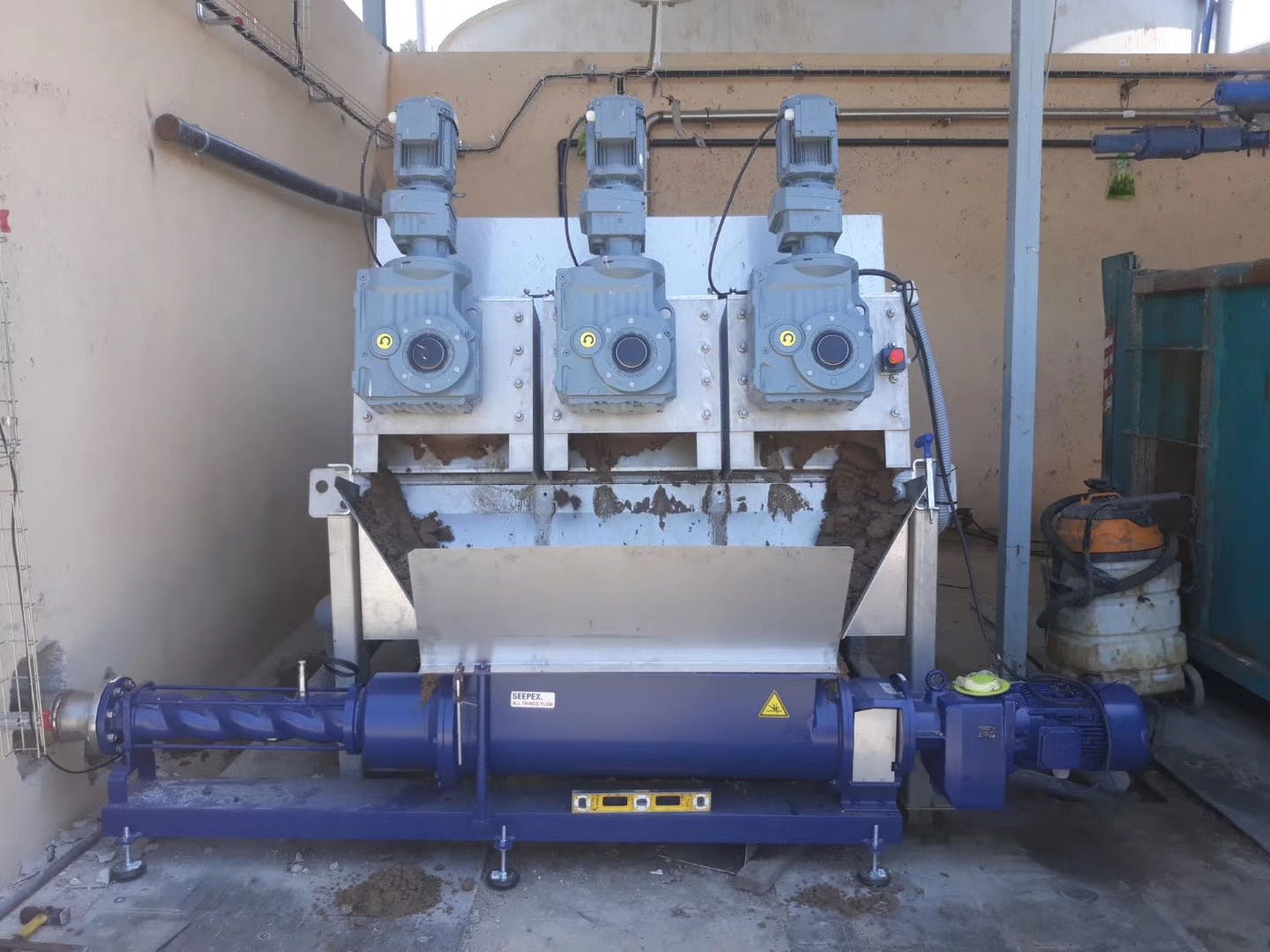
MDS353 screw press dewatering unit on a municipal sludge application in France. Source: Benenv.
Screw Press vs Belt Press: Side-by-Side Decision Table
Screw press figures below are taken from published Benenv MDS specifications and verified field results. Belt press entries describe the general operating characteristics of the technology and contain no supplier-specific specifications.
| Decision dimension | Screw press (Benenv MDS Multi-Disk Screw Press) | Belt press (general technology characteristics) |
|---|---|---|
| Footprint | Compact single-unit envelope; 205 kg (MDS101) to 6,550 kg (MDS404); compact design verified in field use | Generally laid out as a longer machine train with gravity, wedge and pressure zones plus belt run length, which typically consumes more floor area |
| Operator attention | Designed for continuous, low-attention operation; continuous operation verified over up to 3 years on installed units | Generally requires routine operator checks for belt tracking, belt tension, blinding and conditioning control |
| Cleaning demand | Self-cleaning disk stack; verified as a field highlight on units in Vietnam, the United States and Thailand | Belt surface must be washed continuously; spray nozzles and belts are standard wear items |
| Wash water | Documented per model: 24 L/h (MDS101) to 320 L/h (MDS404) | Requires a continuous belt wash-water supply; consumption depends on machine size and is supplier-specific |
| Installed power | 0.2 kW to 8.2 kW across the MDS range; low energy consumption verified in Oman, Canada and France. Industry analysis from Amcon Europe reports screw presses typically use 90–95% less power than centrifuges | Drive and wash-water pump power vary by machine size and are supplier-specific; not specified in this article |
| Noise and vibration | Low speed, low power drive; low noise and vibration verified on MDS403 in Indonesia and MDS302 in the UAE | Noise typically originates from drive units and wash-water sprays; levels are supplier-specific |
| Sludge variability | Specified for municipal, industrial and food-processing wastewater including chemical, textile, paper, pharmaceutical and agricultural sludge; documented on DAF, palm oil, printing and dyeing, chemical and meat processing sludge | Performance generally depends on stable polymer conditioning and consistent feed characteristics |
| Maintenance profile | Simple maintenance verified on multi-year installations in Indonesia and Belgium | Belts, rollers, bearings and spray nozzles form a recognised scheduled wear list |
| Materials | SS304 or SS316L across the range | Construction materials are supplier-specific; stainless options are commonly available |
| Certification | CE M.2024.206.C97307 against EN 60204-1:2018 (UDEM, valid to 2029-03-05); ISO 9001:2015 certificate 18122Q11896R1M (CICC) | Certification scope is supplier-specific and must be verified against the exact model being purchased |
| Strongest fit | Space-constrained and low-attention sites, variable sludge, continuous duty, water and energy-sensitive plants | Plants with existing belt press infrastructure, dedicated operating staff, stable sludge and established wash-water supply |
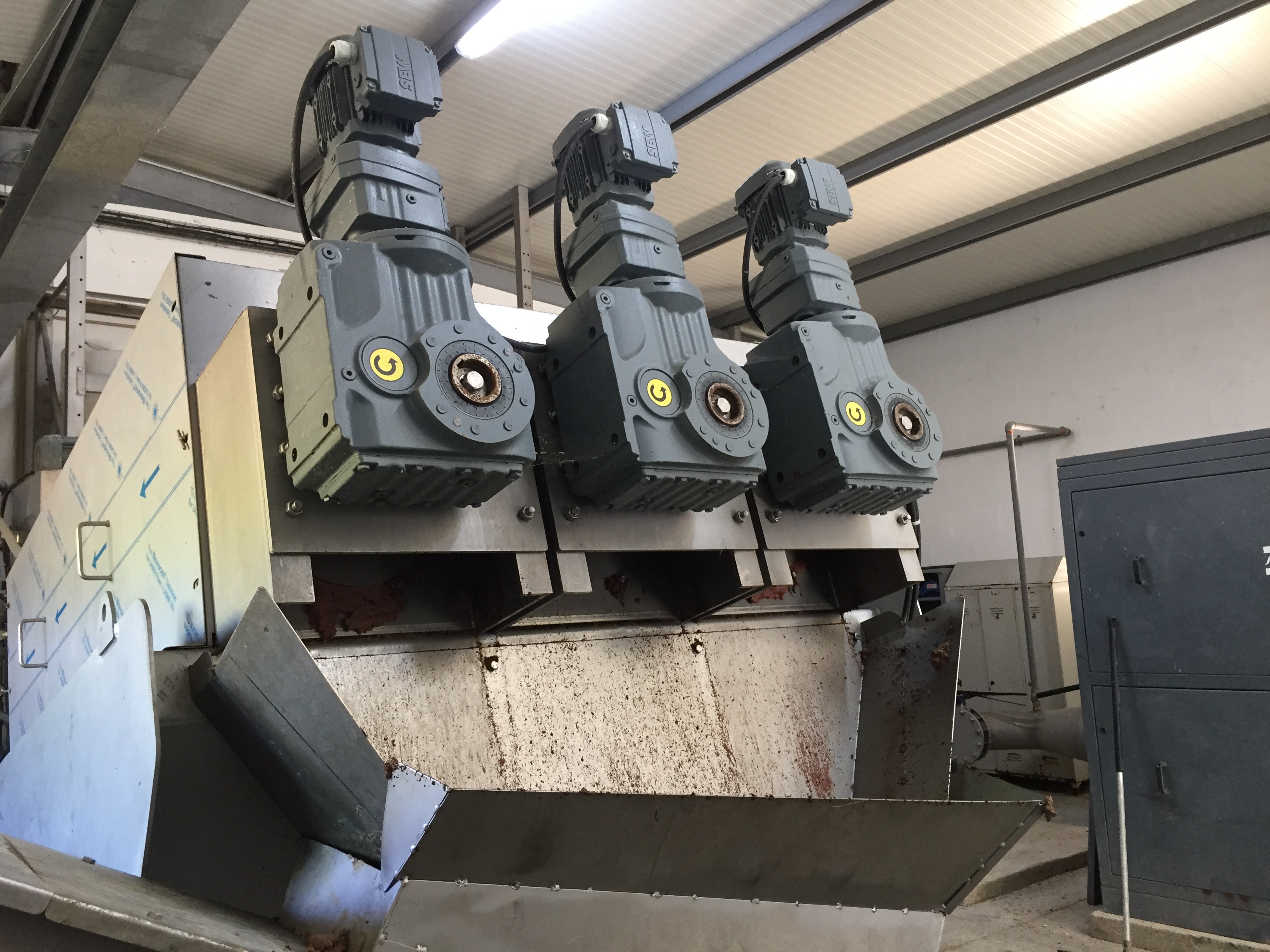
MDS303 screw press handling DAF sludge at a meat processing plant in Portugal, with water-saving operation as the recorded field highlight. Source: Benenv.
One honest note on the comparison: polymer conditioning cost is driven mainly by the sludge itself and by the target cake quality, not by the press category alone. Buyers should compare conditioning demand using their own sludge in a test rather than extrapolating from either technology's reputation.
FAQ: Screw Press vs Belt Press for Sludge Dewatering
What certifications should a screw press sludge dewatering machine carry for an EU project?
For EU-bound equipment, look for CE marking against the applicable electrical safety standard and an ISO 9001 quality management certificate covering the exact product being supplied. Benenv holds CE certificate M.2024.206.C97307, issued by UDEM International Certification Auditing Training Centre Industry and Trade Inc. Co. against EN 60204-1:2018 for the Multi-Disk Screw Press, valid from 2024-03-06 to 2029-03-05. Benenv also holds ISO 9001:2015 / GB/T 19001-2016 certificate 18122Q11896R1M from CICC Certification, covering design and production of the Multi-Disk Screw Press, WAVE Separator, Super Sludge Dryer, Carbonization Furnace and Fermentation Tank. Separately, EU projects should confirm that the plant-level sludge treatment design follows EN 12255-8, the European standard specifying design principles and construction requirements for sludge treatment and storage facilities. Always check that the certificate scope names the model series on your purchase order.
Can a screw press handle the same sludge types as a belt press, including DAF and industrial sludge?
The Benenv MDS range is specified for municipal, industrial and food-processing wastewater treatment, including chemical, textile, paper, pharmaceutical and agricultural applications, and covers 0.12–200 m³/h in capacity and 3–680 kg/h in dry solids throughput depending on model. Documented field applications include DAF sludge dewatering in the United States (three MDS353 units over 2 years) and Canada (MDS302 over 3 years), palm oil mill sludge in Indonesia (MDS403 over 3 years and 2 years), printing and dyeing sludge in Vietnam (MDS202 over 2 years), chemical sludge in India (MDS302 over 3 years), DAF sludge at a meat processing plant in Portugal (MDS303 over 2 years), and sewage treatment plant sludge in Thailand (MDS352 over 3 years). The practical limit is duty size rather than sludge category: the range tops out at the MDS404, so larger duties need multi-unit planning, and cake quality should be confirmed against your own sludge.
What drives the operating cost difference between a screw press and a belt press?
Three cost drivers separate the options. First, electrical power: MDS models are rated from 0.2 kW to 8.2 kW, and an industry comparative analysis published by Amcon Europe reports that screw press technology typically consumes 90% to 95% less power than centrifuges in sludge dewatering. Second, wash water: MDS consumption is documented from 24 L/h on the MDS101 to 320 L/h on the MDS404, while belt presses require a continuous belt wash-water supply whose consumption is machine-specific. Third, labour and maintenance: continuous operation with a self-cleaning disk stack is verified across multi-year installations and requires less routine intervention than technologies with exposed belts and spray systems. Conditioning chemical cost is driven mainly by sludge characteristics and target cake quality rather than by press category, so it should be tested, not assumed.
Can we validate a screw press on our own sludge before committing to a purchase?
Yes, and for sludge dewatering this step should not be skipped. Benenv supplies a minimum order quantity of 1 unit and runs 100% pre-shipment testing on every machine, with third-party inspection available such as SGS. Acceptance is handled through pre-shipment test and FAT inspection, so the machine is verified before it leaves the factory. Commercial terms include delivery on FOB, CIF, EXW or DDP, with 40/60 TT payment. Buyers with unusual sludge streams should ask for the test protocol and the parameters that will be recorded, so the acceptance criteria match the plant's actual performance requirement.
What is the typical lead time, and what support is available after delivery?
Benenv manufactures 100 units per month with a lead time of 30–45 days, and offers OEM and ODM production for buyers who need configuration changes. After delivery, support covers installation guidance, operator training, technical assistance and spare parts supply to keep the unit running reliably over the long term. Benenv was founded in 2011, operates a 20,000 m² factory with around 200 employees and 50 R&D engineers, produces 500 units annually, and exports about 70% of its output to markets including Europe, the United States, Southeast Asia, the Middle East and Australia. The group reports more than 4,500 project references in over 60 countries and 18 agents in countries including France, the United States, the United Kingdom, Malaysia, Indonesia and Saudi Arabia. To move this decision forward with your own sludge data, you can download the Benenv product brochure, review the MDS range at en.benenv.com, or contact the team directly at manager@benenv.com to discuss a sample and quote.
Decision Rules You Can Take to the Next Meeting
Screw press and belt press are both legitimate sludge dewatering choices, and the honest framing is that they carry different operating contracts. Choose the screw press side when operator attention is scarce, floor space is tight, wash water and power are costed items, and the sludge stream shifts through the year. Choose the belt press side when trained operators and belt press infrastructure already exist and the sludge profile is stable enough to keep conditioning under control. Where a plant is being designed or replaced from scratch, the low-attention, continuous, self-cleaning characteristics of a multi-disk screw press are the easier operating model to staff for over the next decade.
Whichever direction the evaluation points, resolve three things before issuing a purchase order: the required capacity in m³/h and dry solids kg/h, the documented certification for the exact model, and the acceptance test that will define whether the machine performed as promised. Benenv MDS units built in SS304 or SS316L, CE certified under EN 60204-1:2018, and manufactured under ISO 9001:2015 give buyers a verifiable starting point for that comparison.
Next Step: Compare on Your Own Sludge
Technology comparisons are useful, but the decision closes on your sludge, your footprint and your operating hours. Send the sludge characteristics, required capacity and site constraints, and the Benenv engineering team will propose the matching MDS model and confirm the acceptance test parameters.
Contact: Roman | Email: manager@benenv.com | Tel: +86 18921318788 | WhatsApp
Address: Xieqiao Industry Park, No.28 Yuedong Rd, Yixing, China
Download: Benenv Multi-Disk Screw Press brochure (PDF) | en.benenv.com
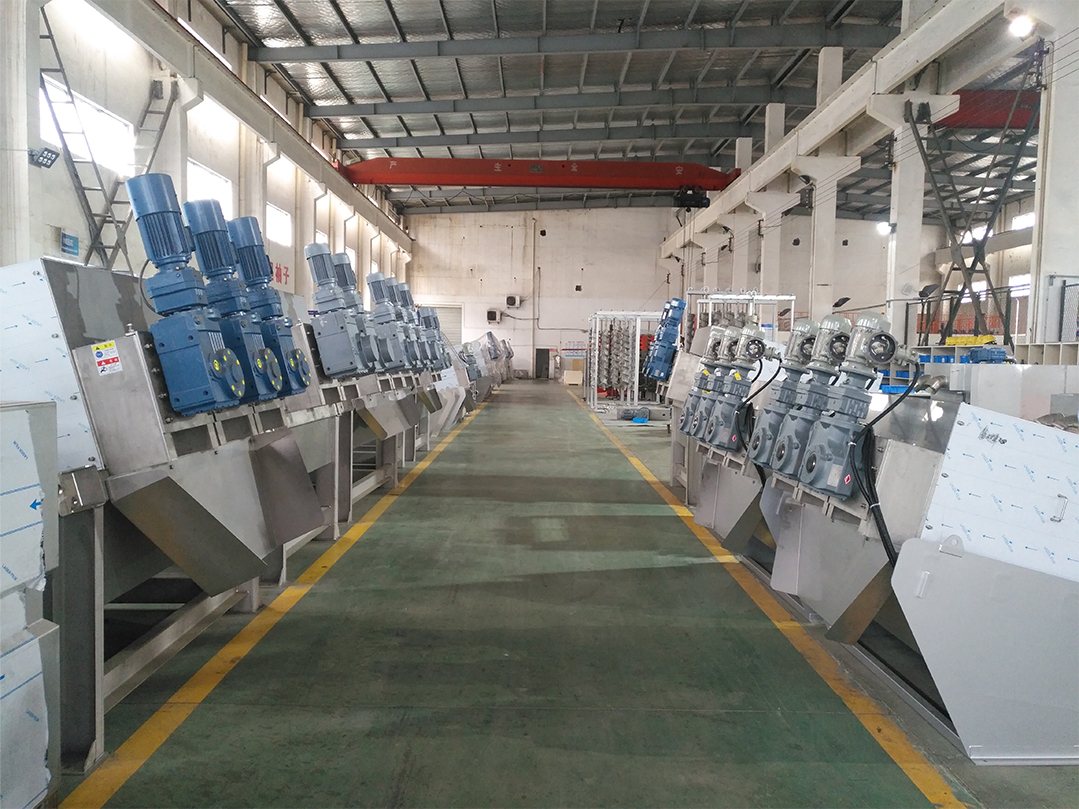
Benenv assembly workshop, where Multi-Disk Screw Press units are built and prepared for 100% pre-shipment testing. Source: Benenv.