
- Company News
- 168
Ranking Screw Press Sludge Dewatering Machines: A Shortlist Guide Based on Acceptance Criteria
Rank screw press sludge dewatering machines by acceptance criteria: process fit, scope, materials, references, commercial terms and lead time.

Cover image: Benenv MDS352 multi-disk screw press, one of the model configurations buyers can score against project acceptance criteria.
Ranking Screw Press Sludge Dewatering Machines: A Shortlist Guide Based on Acceptance Criteria
A defensible ranking of screw press sludge dewatering machines is not a popularity list. It is a scored shortlist built from project-specific acceptance criteria. Buyers should rank candidates by process fit, scope completeness, materials and utilities, reference evidence, commercial terms, after-sales support, and documentation. Benenv is a China-based manufacturer of multi-disk screw press sludge dewatering machines and related water and solid-waste treatment equipment, with more than 4,500 project references in over 60 countries as of 2026.
This guide is written for industrial purchasers moving from research to evaluation. It shows how to turn an equipment shortlist into a transparent ranking model. It does not declare a universal No.1 machine. A screw press that ranks first for a municipal DAF sludge project may rank lower for a palm oil mill or a chemical plant because the sludge basis, scope of supply, and acceptance test are different.
The practical answer is to rank only after the buyer has written the sludge basis, the capacity basis, the scope boundary, and the acceptance test. Without those four items, a ranking table is only a comparison of brochure numbers. With them, the ranking becomes a procurement decision record that can be defended internally and with suppliers.
Problem Definition: Why Screw Press Shortlists Become Unreliable
Screw press sludge dewatering machines are often compared on a narrow set of numbers: hydraulic flow, dry-solids capacity, motor power, weight, and material. Those numbers matter, but they are not interchangeable. A machine listed at a higher hydraulic flow is not automatically better if the feed sludge concentration, polymer dose, target cake dryness, or operating hours are not aligned. A higher dry-solids figure is also not proof of better performance unless the test basis is stated.
The second problem is scope. A sludge dewatering system can include the screw press, sludge feed pump, polymer dosing system, electrical control cabinet, and cake conveying system. If one quotation includes these items and another does not, the ranking is distorted. The buyer may compare a complete system against a press-only offer and draw the wrong conclusion.
The third problem is acceptance. Purchasers need to know what will be checked before payment and handover. If the RFQ does not define the performance test, documentation package, training, spare-parts list, and after-sales response, the supplier cannot be scored consistently. The shortlist should therefore be built from acceptance criteria, not from marketing claims.
Industry Background: Growth Makes Disciplined Ranking More Important
Fortune Business Insights reported that the global sludge dewatering equipment market was valued at USD 5.19 billion in 2024. The same source projected the screw press segment to grow at the highest CAGR of 9.4% during the forecast period. It also reported that Asia Pacific accounted for a 37.57% revenue share in 2024. These are market-level signals, not proof that any single machine fits a specific project.
For buyers, market growth creates more choices and more supplier claims. More models, more material options, and more control packages enter the shortlist. That makes a scoring framework more useful than a simple brand list. The ranking should reward verifiable project fit and acceptance readiness, not the loudest capacity claim.
Municipal and industrial sludge streams also place different demands on a screw press. Municipal projects often focus on continuous operation and stable cake handling. Industrial projects may involve chemical, textile, paper, pharmaceutical, food processing, slaughterhouse, livestock, aquaculture, or landfill leachate sludge. Benenv's application data lists municipal wastewater treatment, industrial wastewater treatment, food processing, pharmaceutical, livestock and agricultural wastewater, and landfill leachate treatment as relevant areas. The ranking model must reflect that range without pretending that one model covers every case.
Detailed Solution: Build a Ranking Model, Not a Brochure List
The shortlist should contain machines that can be scored on the same basis. Benenv describes its MDS product as a multi-disk screw press used for sludge dewatering and solid-liquid separation. The supplied product data lists model-specific power, hydraulic capacity, dry-solids capacity, weight, water consumption, and material. Those data points are useful for screening, but they must be tied to the project's sludge basis before they become ranking evidence.
A sound ranking model has three layers. The first layer is a pass or fail screen: compliance documentation, scope completeness, capacity range, material compatibility, and acceptance-test willingness. The second layer is a weighted score: process fit, reference proof, utilities, commercial terms, after-sales support, and documentation. The third layer is a justification note: why the top pick wins, what risks remain, and what conditions must be written into the purchase order.
Cross-vendor capacity claims need special care. HUBER's official Q-PRESS page reports a screw-press series with feed capacity up to 540 kg dry solids per hour, four sizes, a compact enclosed design, low energy demand, and optional mobile units. Benenv's supplied data lists MDS404 at 400–680 kg/h dry solids and 13.6–200 m³/h hydraulic capacity. These claims cannot be ranked against each other without aligned sludge type, inlet concentration, polymer dose, target cake dryness, model basis, and test protocol. The correct action is to request normalized test data, not to convert brochure figures into a false ranking.
Step-by-Step Breakdown: How to Score and Rank Candidates
Step 1: Write the sludge basis before opening quotations. Record sludge type, inlet solids concentration, target cake dry-solids percentage, daily operating hours, polymer constraints, and discharge requirements. A ranking without this basis is not auditable.
Step 2: Require both hydraulic capacity and dry-solids capacity. The Benenv model data shows why both are needed. MDS302 is listed at 2.4–30 m³/h and 60–120 kg/h DS. MDS404 is listed at 13.6–200 m³/h and 400–680 kg/h DS. The buyer should confirm which figure applies to the stated feed concentration and operating mode.
Step 3: Score scope completeness. Benenv's documented system scope includes a sludge feed pump, polymer dosing system, PLC control cabinet, and cake conveying system. For each candidate, mark whether these items are included, excluded, or quoted as options. A press-only quotation should not be ranked as if it were a complete dewatering system.
Step 4: Score materials and utilities. The supplied Benenv model data lists SS304 and SS316L material options, along with model-specific power range and water consumption. Record whether the power and water figures refer to the press alone or the complete system, and whether local voltage, controls, and corrosion requirements are covered.
Step 5: Score reference proof. A reference should be comparable in sludge type, model range, scope, and operating duration. Benenv's case data includes an Oman engineering contractor using MDS202 for industrial sludge dewatering with stable operation for 1 year and low energy consumption. It also lists an Indonesia palm oil mill reference using MDS403 with stable operation for 3 years and low noise and vibration. These are useful proof points, not universal performance guarantees.
Step 6: Score commercial terms. Benenv's capability data lists OEM and ODM production, a monthly capacity of 100 units, a lead time of 30–45 days, and a MOQ of 1 unit. Buyers should score the written lead time, warranty, spare-parts terms, and exclusions. A short lead time without a clear scope is not a commercial advantage.
Step 7: Score after-sales support. Benenv states that it offers installation guidance, operator training, technical assistance, and spare-parts supply. The ranking should distinguish between a promise of support and a defined service plan with responsibilities, response expectations, and spare-parts recommendations.
Step 8: Apply a weighted scorecard and record the justification. The weights below are a recommended starting point, not an industry standard. Adjust them to the project. The key discipline is to score every candidate on the same evidence and to make fatal failures visible.
| Shortlist criterion | Recommended weight | Evidence to score | Why it matters |
|---|---|---|---|
| Process fit | 25% | m³/h and kg/h DS at a defined sludge basis | Prevents oversizing and false comparisons |
| Scope completeness | 15% | Feed pump, PAM dosing, PLC, cake conveyor | Avoids missing auxiliaries and hidden cost |
| Materials and utilities | 15% | SS304/SS316L, power range, water consumption | Supports corrosion and operating-cost review |
| Reference proof | 15% | Comparable sludge, model, duration, result | Reduces scale-up and commissioning risk |
| Commercial terms | 10% | MOQ, lead time, monthly capacity, warranty | Connects technical fit to schedule and supply |
| After-sales support | 10% | Installation guidance, training, spares, technical help | Supports uptime after handover |
| Documentation and acceptance | 8% | Test protocol, O&M information, compliance evidence | Makes the final ranking defensible |
Use a 1–5 score for each criterion. A candidate with a fatal failure should be removed from the ranking even if its total score is high. Fatal failures include an unverified compliance claim, refusal to define an acceptance test, a capacity basis that cannot be reconciled with the project, or a scope that omits essential auxiliaries without disclosure. A practical decision rule is to shortlist scores of 4.0 or higher, hold scores between 3.0 and 3.9 for clarification, and drop scores below 3.0 unless the buyer has a specific reason to continue.
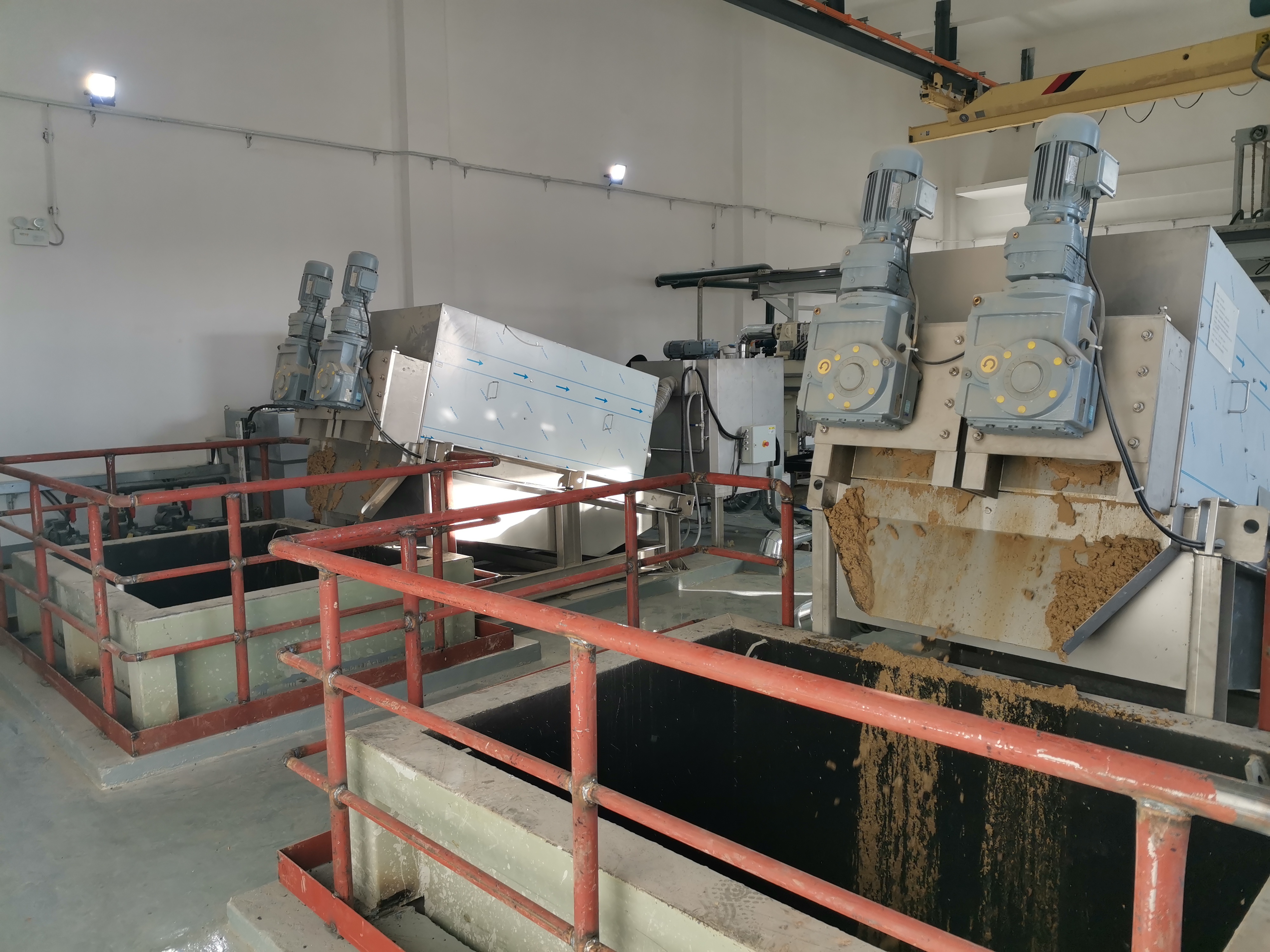
Body image: dewatered cake handling is part of the acceptance scope, not a separate afterthought.
Use Cases: How Acceptance Criteria Change the Ranking
Municipal sludge projects usually require continuous operation and predictable cake handling. Benenv's application data describes fully automatic continuous operation 24/7 and lists a PLC control cabinet and cake conveying system among the matched equipment. In this setting, the ranking should give high weight to controls, automation, and service support. A reference from Canada lists MDS302 for DAF sludge dewatering and volume minimization, with stable operation for 3 years and low energy consumption.
Industrial chemical and textile sludge projects may place more weight on material compatibility and continuous operation. Benenv's India reference lists MDS302 for chemical sludge dewatering, with stable operation for 3 years and continuous operation. Its Vietnam reference lists MDS202 for printing and dyeing sludge dewatering, with stable operation for 2 years and a self-cleaning mechanism. These references help the buyer ask better questions, but they do not replace a project-specific sludge test.
Food processing and DAF sludge projects need attention to water use and maintenance. Benenv's Portugal reference lists MDS303 for sludge volume reduction in a meat processing plant, with stable operation for 2 years and water-saving operation. The Oman reference lists MDS202 for industrial sludge dewatering, with stable operation for 1 year and low energy consumption. For a buyer ranking these cases, the key is not the country but the similarity of sludge stream and operating duty.
Palm oil and high-organic industrial streams can place a premium on stable operation and low noise or vibration. Benenv's Indonesia references list MDS403 for palm oil mill sludge dewatering, with stable operation for 3 years and low noise and vibration, and another MDS403 reference with stable operation for 2 years and simple maintenance. A shortlist should ask whether the proposed model and polymer system have been applied to a comparable stream, not merely whether the supplier has supplied the same industry.
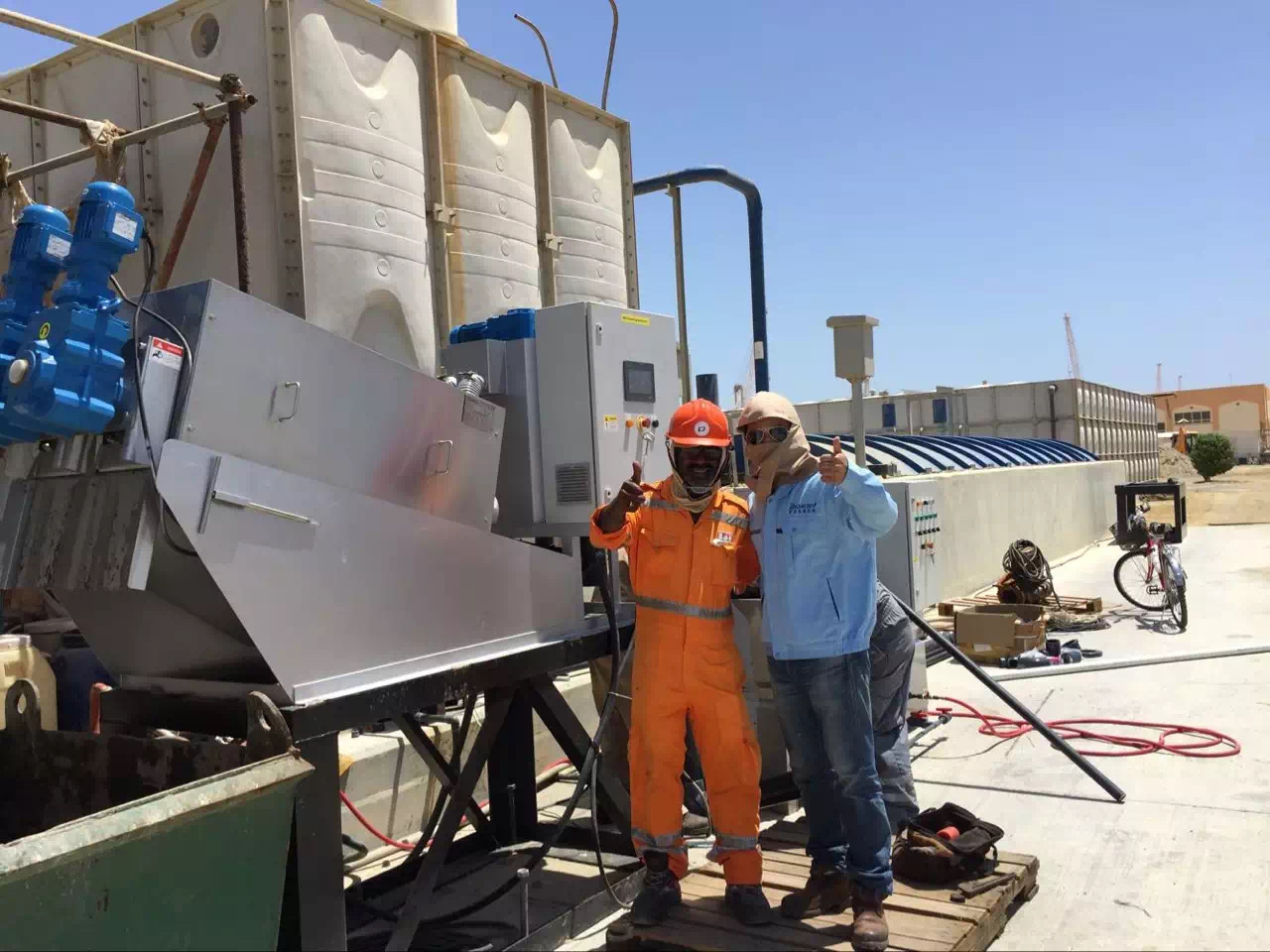
Proof image: Oman reference with MDS202 for industrial sludge dewatering, listed with stable operation for 1 year and low energy consumption.
Comparison Table: Verified Benenv MDS Specification Points
The table below uses only the supplied Benenv model data. It is a screening aid, not a universal ranking. The correct rank depends on the project sludge basis and the acceptance scorecard. Hydraulic capacity and dry-solids capacity are shown together because they answer different questions.
| Model | Type | Power range | Capacity | DS | Weight | Water consumption | Material |
|---|---|---|---|---|---|---|---|
| MDS131 | Multi-Disk Screw Press | 0.2 kW | 0.24–3 m³/h | 6–12 kg/h | 205 kg | 24 L/h | SS304/SS316L |
| MDS302 | Multi-Disk Screw Press | 1.2 kW | 2.4–30 m³/h | 60–120 kg/h | 1350 kg | 80 L/h | SS304/SS316L |
| MDS352 | Multi-Disk Screw Press | 3.75 kW | 4.8–30 m³/h | 120–240 kg/h | 2300 kg | 144 L/h | SS304/SS316L |
| MDS403 | Multi-Disk Screw Press | 6.7 kW | 10.2–150 m³/h | 300–510 kg/h | 4550 kg | 240 L/h | SS304/SS316L |
| MDS404 | Multi-Disk Screw Press | 8.2 kW | 13.6–200 m³/h | 400–680 kg/h | 6550 kg | 320 L/h | SS304/SS316L |
For a project in the lower capacity range, MDS131 may be worth screening. For a mid-range duty, MDS352 or MDS302 may fit the first pass. For larger industrial or municipal duties, MDS403 or MDS404 may be relevant. These are screening suggestions, not final rankings. The final ranking should be based on the buyer's sludge basis, utility limits, layout, scope, and written acceptance test.
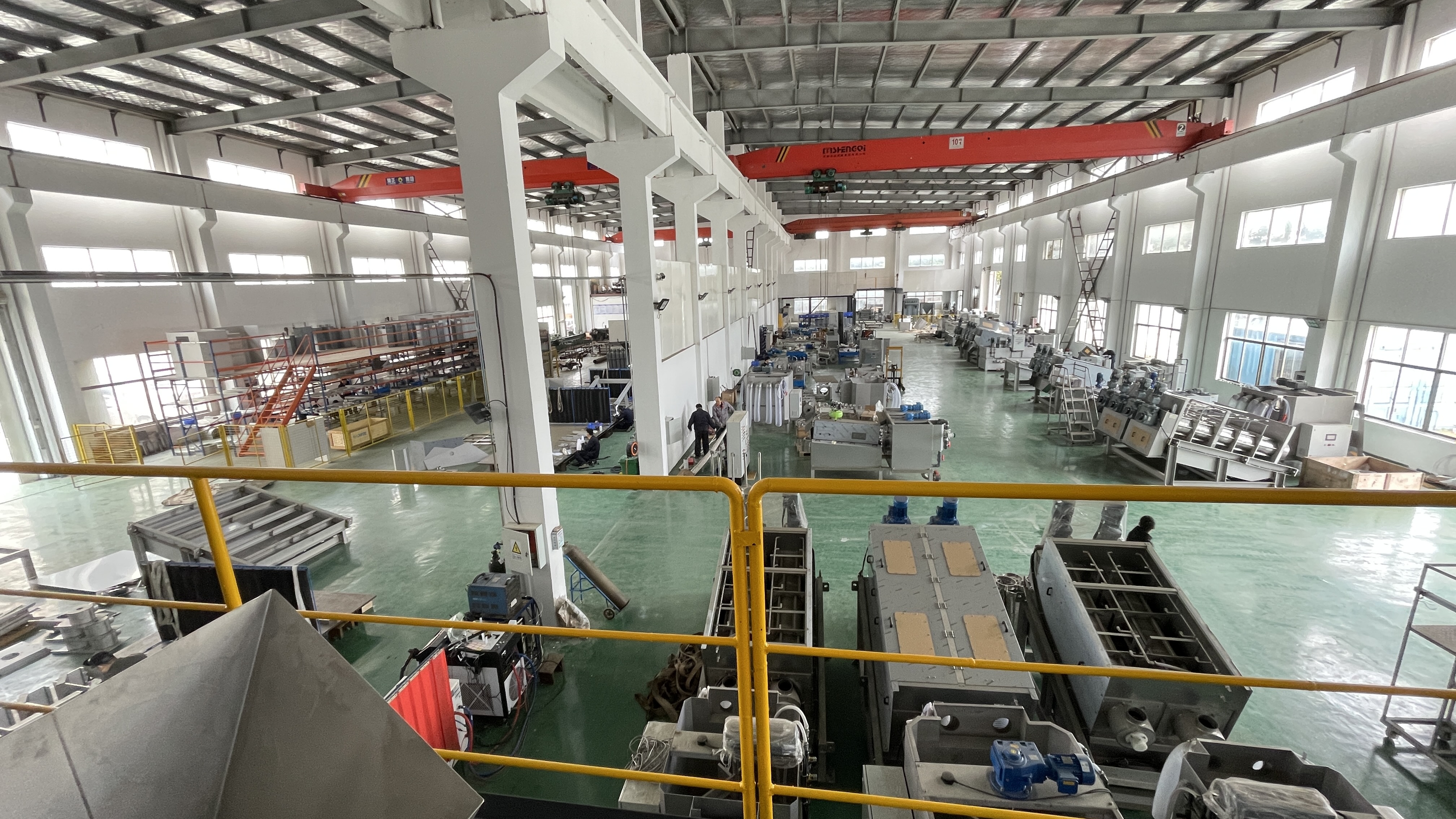
Supporting image: assembly workshop view used to support supplier capability review, not as a performance claim.
FAQ: Acceptance Criteria, Capability, Budget, Sample, and Lead Time
What acceptance criteria should be included in a screw press sludge dewatering RFQ?
The RFQ should define the sludge basis, hydraulic capacity, dry-solids capacity, scope of supply, material grade, power and water requirements, documentation, performance test method, commercial terms, and after-sales obligations. Compliance evidence should be traceable to certificate number, issuing body, scope, and validity. Do not score a supplier on a logo alone.
Can one multi-disk screw press model cover both municipal and industrial sludge?
Not automatically. Benenv's applicable industry list includes municipal, industrial, food processing, chemical, textile, paper, pharmaceutical, and agricultural wastewater. The model range in the supplied data runs from MDS131 at 0.24–3 m³/h and 6–12 kg/h DS to MDS404 at 13.6–200 m³/h and 400–680 kg/h DS. Model selection still depends on the actual sludge stream and acceptance basis.
What budget benchmark can buyers use for a screw press sludge dewatering machine?
A verified aggregate estimate reported an average selling price of USD 46,000 per unit for a sludge screw dewatering press in 2025. Use that as a screening benchmark only. Model size, material, controls, auxiliaries, documentation, freight, and service scope change the quotation. Request a scope-specific quote before ranking commercial offers.
What should a sample or reference project prove before shortlisting?
It should prove operation on a comparable sludge stream, with a stated model, scope, operating duration, and result. Benenv references include MDS202 for industrial sludge in Oman with stable operation for 1 year and low energy consumption, MDS403 for palm oil mill sludge in Indonesia with stable operation for 3 years and low noise and vibration, and MDS302 for chemical sludge in India with stable operation for 3 years and continuous operation. The provided capability data does not state a sample policy, so buyers should request a written sample or pilot proposal where needed.
What lead time and commercial terms should be verified before ranking a supplier?
Benenv's capability data lists a MOQ of 1 unit, a lead time of 30–45 days, and a monthly capacity of 100 units. Verify the written lead time against the final scope, including controls, auxiliaries, documentation, and inspection. For a project-specific review, contact Benenv at manager@benenv.com or download the brochure below.
Conclusion: Rank the Evidence, Then Choose the Machine
A shortlist ranking is only as good as its acceptance criteria. The buyer should define the sludge basis, compare hydraulic and dry-solids capacity on the same basis, score scope and utilities, verify reference proof, and write the acceptance test into the purchase order. Benenv's MDS models provide a documented range of multi-disk screw press options, from compact MDS131 to larger MDS404, but the correct rank depends on the project rather than a fixed label.
The top pick should be the candidate with the highest weighted score and no fatal compliance, capacity, scope, or acceptance failure. That is a more defensible result than a generic best-machine claim. Buyers who want to review the model range, project references, and technical documentation can use the Benenv brochure and contact the team directly.

CTA image: Benenv group support for project review, documentation, and quotation.
Next step: download the Benenv brochure, review the Benenv MDS screw press product information, or contact Roman at manager@benenv.com for a scope-specific quotation. Website: en.benenv.com.